
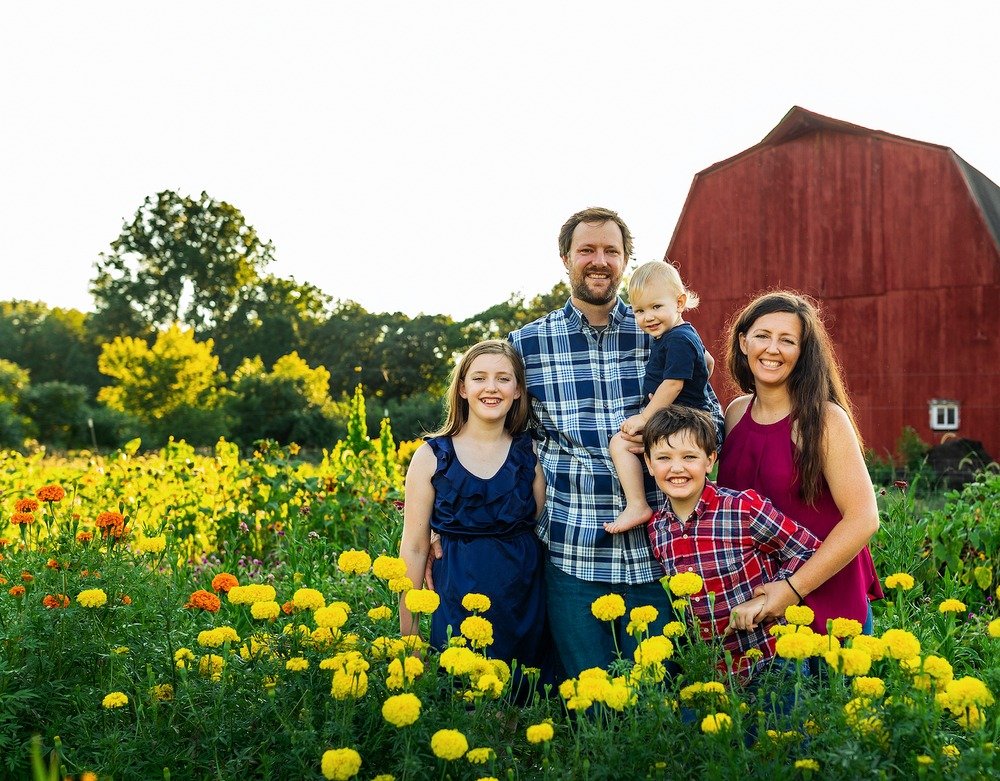
The Beauty Of Local Flowers On And Off The Farm: Raindance Farm
Summer is in full swing here in Michigan, and what better way to complement these bright days than with a beautiful bouquet of locally grown flowers? I have seen few flowers as unique and vibrant as those from Whitmore Lake’s Raindance Farm. Kristen Muehlhauser, owner of Raindance Farm, grows a wide variety of flowers year-round, from summer lilies, peonies, and dahlias, to winter-grown daffodils and andenomes. We met with Kristen to discuss how Raindance Farm came to be.
Kristen loved gardening and participated in Project Grow, an organization providing garden resources and plots in Ann Arbor. When she got her plot, she read Animal, Vegetable, Miracle by Barbara Kinsolver, a book about a family sustaining themselves solely off their local food supply for a year. Kristen discovered her love of growing food sustainably. Ten years later, the charm of a farm in Northfield Township caught Kristen’s attention, and she and her husband purchased it.
Kristen emanates kindness and is committed to quality, community, and sustainability in her farming practices and her personal life. I hear customers talk about how wonderful her bouquets are, and it’s clear after meeting with her that the farmer behind them is just as lovely. Raindance Farm farms in a way that nourishes both the environment and the local community. Opportunities for U-Pick flowers will hopefully arise sometime in 2026, but in the meantime, you can find her bouquets at the Ann Arbor Farmers Market and right here at Argus Farm Stop.

Slow and Steady Wins the Race: Michigan Strawberries at Slow Farm
Strawberries are one of the most popular fruits in the United States, but the vast majority of them are grown at the detriment to our soul health. One solution to the problem of mass production is for consumers to change the way they consume by purchasing produce in season from local farmers. In doing so, we guarantee that we are eating fruits and vegetables while they are most flavorful and nutritious. The benefit of purchasing strawberries from farms like Slow Farms is being able to know exactly where and how the berries are grown.

Ramps, Organic Certifications, and more with Monroe Family Organics
At Argus Farm Stop, there are a few items that come in the store that signal a real beginning to the new growing season. We begin to see green garlic, green onions, and radishes as the sun comes out. But as the days turn from just above freezing, to so sunny your soul begs to stay outside, we see the arrival of asparagus, foraged morels, and ramps, signifying a moment of the season. Ramps are a special item in our store due to their cultivation, or lack thereof. Farmers can’t grow ramps at scale for the most part, so when ramps are harvested, it’s more of a foraging activity than a farming one. Our good friends at Monroe Family Organics in Alma, Michigan supply us with the vast majority of our ramps. We chatted with them to learn more about how they harvest Ramps, how they sell local produce to consumers, and different certification options for farms.
We’re always excited to have produce that is native to our region, such as strawberries, and ramps. Ramps are native to the forests of eastern North America. “They’re an onion type plant. They look like a lily and grow in the woods.” Fred Monroe of Monroe Family Organics tells us. Along with other alliums like green onions and garlic, ramps grow from a bulb in the ground, growing two leaves out in the spring. This time of late April into May is when the ramps are visible and able to be harvested by foragers. (Jessee and Ram, 2024)

Maple Syrup Season In Michigan: An Interview with Whitney Farmstead
As the weather warms, people regain energy laid dormant during the sleepy winter. Certain birdsong, the sound of peeper frogs, and the occasional sunny, 50° day indicate that spring is on the way. One indicator of spring’s coming is the flow of sap from our local maple trees. Alex Blume and I, Bella Martinez, of Argus Farm Stop recently spoke with Malaika Whitney and Matthew Haarklou of Whitney Farmstead, about the process of maple production during this special month. Sitting in their sugar shack, we discussed the farm’s history, the local community, and tradition on the farm.
The Whitney Farm, located in Dexter, has been with the Whitney family since 1900, when Malaika’s great-great grandfather, Estley purchased 40 acres. “He had a lung issue, so he bought land to get out of the city. They were small and diversified [then].” The farm grew and shrank over the decades, but maple sugaring has been a part since the beginning.